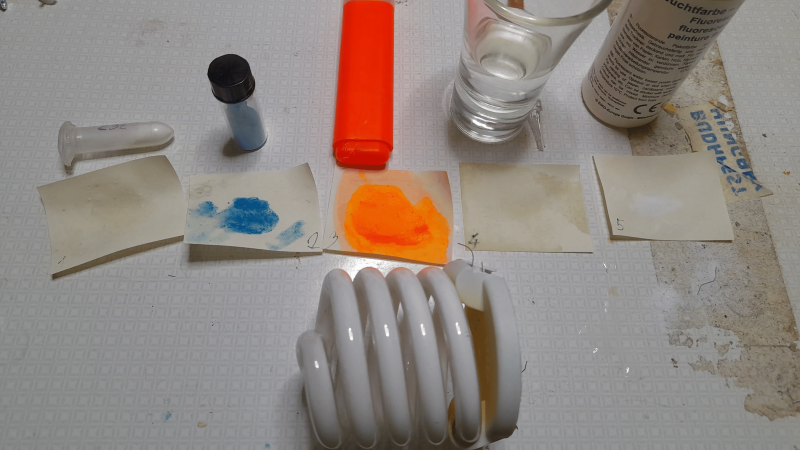
A selection of materials sits on a counter. There is a fluorescent light bulb, two papers stained with dyes, and a few other pieces of paper with no obvious staining.

Building Your Own X-Ray Detector Screen

Fluoroscopy is probably the best-known method of X-ray imaging: an X-ray beam passes through the subject to be imaged, and the transmitted X-rays illuminate a phosphor screen. Dense objects, such as metal or bone, cast a shadow on the screen, which provides a real-time image of the subject’s interior. Already having access to X-ray sources, [MarcellF]’s next step was to investigate common phosphor materials, then synthesize his own.

Most common materials that fluoresce under ultraviolet light showed no activity under X-rays: fluorescein, quinine, UV fluorescent paint, and common fluorescent minerals emitted no noticeable glow under 80 kV X-ray stimulation. However, strontium aluminate phosphors did fluoresce well, with a strong afterglow, as did the phosphors in a fluorescent light bulb, some LEDs, and an electroluminescent panel. The electroluminescent panel, which used a zinc sulfide phosphor, was almost as bright as the gadolinium oxysulfide screen from a CT scanner’s detector and had no noticeable afterglow.

Continue reading “Building Your Own X-Ray Detector Screen”

The Pacemaker Patch

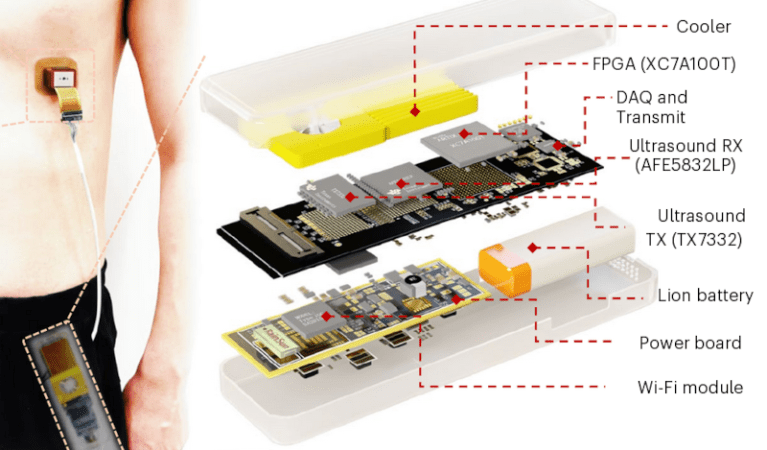
A pacemaker is implanted to send signals that regulate a patient’s heartbeat, and to do that, you need power. That means they require battery changes, and when the device in question happens to be inside your chest, that means surgery. Sometimes as often as every five years. [Alex Music] writing in Spectrum notes that researchers have a new paper discussing a possible alternative: a tiny patch stuck to the outside of the chest that uses ultrasound to pace the heart rhythm.

Rats, pigs, and human heart cell samples have all responded to the system. You might wonder how ultrasound could make your heart beat, but the new pacemaker relies on gene therapy to sensitize your heart cells to the high-frequency waves. The therapy is delivered by a simple injection.

In addition to the chest patch, the patient would need a data and power module that they could keep in their pocket. The gene therapy doesn’t alter your DNA but introduces RNA to make heart cells produce a sound-sensitive protein in the cell’s ion channels. When stimulated, the ion channels admit calcium, which causes the heart to beat.

Pacemakers are nothing less than a modern technological marvel. Maybe if this catches on, cheap junked pacemakers will show up on the surplus market. They could be useful.

Converting A Scanning Electron Microscope Into A TEM Is Surprisingly Easy

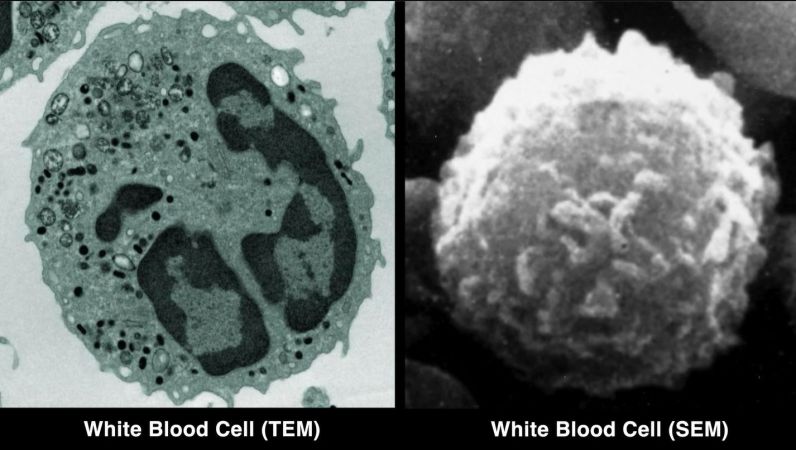
Although both a SEM and a TEM are electron microscopes, their working principles and images are very different. Whereas an SEM uses secondary electrons ejected after bombarding a sample’s surface with primary electrons, a TEM works more like an X-ray machine, with a sensor placed behind the sample to record primary electrons after they pass through said sample. It is, however, possible to turn a SEM into a TEM with some creativity, as [ProjectsInFlight] recently did with his SEM.

We previously covered how the SEM in the video was saved from being scrapped and subsequently revived, and now it is getting a pretty nice upgrade. That said, this SEM to TEM change isn’t anything new, with so-called STEM imaging having been possible for ages using a rather simple reflecting adapter. The problem here is that such adapters cost enough to make you dread filing a budget request, yet they are simple enough that you might be able to DIY one.

The main concern with the DIY adapter was clearance between the sample holder and the fragile components inside the chamber. This turned out to be a hair under 14 mm (0.55″), giving not a lot of space to work with, but that was relative to the standard bulky sample holder. With a thinner sample plate machined out of aluminum, significantly more space became available, including for the primary electron mirror and shield for the secondary electrons.

Some more lathe, milling, and tapping work later, the entire sample holder came together. During testing a hack was implemented to enable adjusting the mirror angle while in the evacuated vacuum chamber so that the adapter could be dialed-in. Subsequently, a first sample was imagined in the form of gold nanoparticles, which revealed a leaky secondary electron shield due to bypassing.

Further testing revealed that the shield needed to extend much higher to meaningfully block secondary electrons, after which the TEM image massively improved. Subsequently, a previously expired mosquito graciously donated its wings to science, with TEM imaging clearly revealing the delicate structures within these wonders of evolutionary design.

The next challenge will be to TEM image biological cells, which require substantial preparation.

This isn’t the first STEM converter we’ve seen. The SEM has a long checkered history that we’ve talked about before, too.

Continue reading “Converting A Scanning Electron Microscope Into A TEM Is Surprisingly Easy”

Introducing Boron Buckyballs

A buckminsterfullerene, also known as a buckyball, is typically a fullerene consisting of sixty carbon atoms (C60) arranged in a way that resembles a football-like sphere. Extending this arrangement to other types of atoms has until now however proven as elusive as finding non-carbon-based lifeforms. In a paper by [Hyun Wook Choi] et al. and published in Chemical Science the discovery of boron buckyballs is detailed. There is also a soft-paywalled article in the Chemical & Engineering News magazine for a higher-level perspective.

The discovered boron-based buckyball ups the number of atoms to eighty, forming B80 (boron fullerite) with a slightly larger diameter than C60 at 0.85 nm versus 0.71 nm. Perhaps more interesting are the claims by the authors that boron fullerite may have more practical applications than its carbon-based cousin, mostly due to it being predicted to be a semiconductor with an 0.8 eV energy gap and better electron acceptance that provides interesting doping prospects.

Producing these boron structures used laser vaporization with a helium carrier gas that was seeded with argon to increase cooling efficiency. Inside this boron cluster the reported structures were then discovered and characterized as described in the paper.

Obviously, going from a fascinating laboratory discovery to bulk production won’t be easy, and the predicted properties of boron fullerite may turn out to be incomplete or have a dark side that we aren’t aware of. Regardless, they’re bound to be more useful at least than the carbon version that’s remained mostly a curiosity despite many years of research.

Discovery Of An Active Wind From The Milky Way’s Central Black Hole

One of the fun aspects of astrophysics is that much of it involves phenomena which you cannot exactly study from up close, with the supermassive black hole (SMBH) at the center of this galaxy – called Sagittarius A* (Sgr A) – being a great example. Although it’s been predicted since 1971 that black holes like Sgr A radiate energy which then pushes away nearby matter to create something akin to solar wind, this had so far not been proven. Now astronomers have discovered evidence for this emanating from Sgr A*.

Using five years worth of observations made with the Atacama Large Millimeter/Submillimeter Array (ALMA) and correlating it with other observations, a Southern Lobe of movement was identified, along with evidence for a Northern Lobe. Unlike a star where you are dealing with relatively massive quantities of matter being hurled into space, in the case of a very quiet SMBH like Sqr A* you are talking about occasional small wisps of gas of which a fraction gets turned into the radiation that then exerts pressure on the remaining gas.

It is speculated to be exactly this quiescent nature of Sgr A* that makes it so difficult to find evidence of SMBH wind, though one could also argue that having a well-fed SMBH whose event horizon rapidly expands would be fascinating from an astrophysics perspective, but less exciting for any nearby inhabited planets.

Desalinating Seawater With Solar And No Brine

Although desalination is very commonly used these days to convert seawater into fresh water, one of the major disadvantages of current approaches is that commercial desalination plants produce a lot of brine, which has to be dumped somewhere ideally without causing major environmental issues. A new solar-thermal method as demonstrated by [Luheng Tang] et al. was published in Light: Science and Applications, with accompanying PR article.

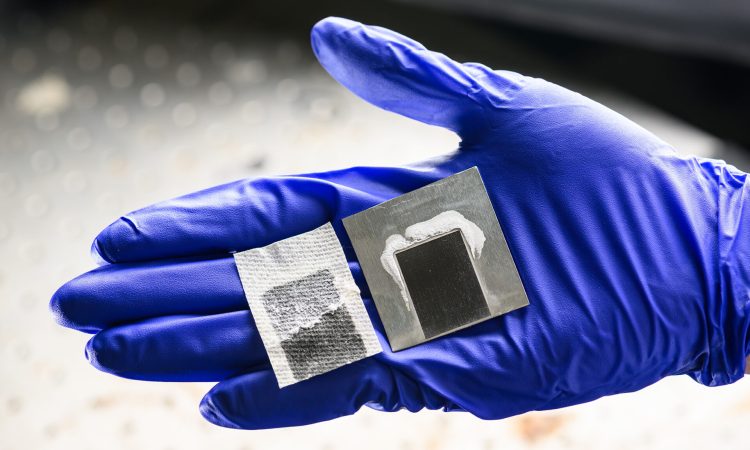
This method is claimed to require no pre-treatment or leave brine, using special panels that wick water across their surface and then use solar radiation to distill this water. This differs from previous similar methods through a special surface treatment that prevents build-up of salts which would require cleaning or replacement.

The salts and other contaminants that would normally end up in the brine slough off these cells and can then be further processed to recover everything from plain table salt to lithium as well as gold, uranium and other substances of interest that are prevalent in seawater.

So far these self-cleaning cells have been tested with water from a number of oceans with a claimed 74% solar-to-vapor conversion efficiency and nearly 100% salt extraction. As always the challenge will be in scaling this up to industrial levels, but so far it looks promising.

Apparently what a fusion power plant should look like

Less Than 10 Years? Commonwealth Fusion Systems Applies To Plug Into Grid In 2030s

Whenever the topic of fusion power comes up, someone will say it’s only 10 years away from commercialization in an excited tone, and someone older or more cynical will point out that it’s been 10 years away since Eisenhower was president. So it’s with a certain-sized crystal of sodium chloride that we share the news here that the US-based Commonwealth Fusion Systems is applying to feed 400MWe into the grid there by the early 2030s.

The early 2030s is, notably, less than ten years from now.

Commonwealth Fusion Systems isn’t a bunch of nobodies out to suck up venture capital; they’re a talented group of researchers from MIT’s well-known plasma laboratory out to suck up lots of venture capital and hopefully build reactors along the way. So far, the second part is going better than the first: they’ve raised a couple billion dollars, which has let them make great strides in building their SPARC reactor– like crafting the big magnet we told you about in 2021. As that article describes, SPARC is the precursor to the later, larger ARC reactor they hope to hook to the grid in slightly under a decade. Alas, SPARC remains under construction as of this writing. ARC is evidently in the final planning stages, with a physical location determined and grid-tie applied for at the “Fall Line Fusion Power Station” in Virginia.

CFS’s reactors are of the Tokamak type that has been favoured at universities since the 1970s. From China to Europe’s ITER who are also planning to produce power before another decade passes— though not, notably, into a power grid. While promising, Tokamaks aren’t the only game in town, either– steampunk startup General Fusion started making plasma last year, though while if it works it has some big advantages, that one is probably the traditional “ten years away” still.

What do you think? Will fusion power be in the grid before humans make it back to the moon? Add the flying-car potential of eVTOL and we might finally get close to the future we were promised.